Sod Installation Cost in Ottawa: What You’ll Actually Pay
Professionally installed sod in Ottawa runs about $3.00 to $4.00 per square foot, or roughly $3,000 to $4,000 for a 1,000-square-foot lawn. But the number that matters isn’t just the price of the sod.
A contractor may need to remove the existing grass, dispose of it, bring in soil, reshape the yard, move materials through a side gate, and install the new sod. Two lawns with the same square footage can therefore have very different prices.
That’s why there isn’t one reliable Ottawa-wide price per square foot. Published local prices vary, and the scope of work included in those prices is not always the same.
We install sod at $3.00 per square foot for front yards and $3.25 per square foot for backyards. A full package with sod, screened topsoil, fertilizer, peat moss, installation and delivery runs up to about $4 per square foot, so confirm exactly what each quote includes before comparing figures.
The important point is simple: don’t compare the price per square foot until you know what each contractor is actually including.
What does sod installation cost in Ottawa?
As a starting point, currently published Ottawa prices put some professionally installed sod projects in the neighbourhood of $3.00 to $4.00 per square foot.
That would put a 1,000-square-foot lawn at approximately:
$3,000 to $4,000
A straightforward lawn with good access and suitable soil can be much easier to install than a backyard where turf has to be removed, soil has to be brought in and everything has to be carried through a narrow gate.
Your final quote may also be higher if the project involves substantial grading, additional soil, drainage work or difficult disposal.
Rough cost examples
| Lawn size | At $3.00/sq. ft. | At $4.00/sq. ft. |
|---|---|---|
| 500 sq. ft. | $1,500 | $2,000 |
| 1,000 sq. ft. | $3,000 | $4,000 |
| 1,500 sq. ft. | $4,500 | $6,000 |
| 2,000 sq. ft. | $6,000 | $8,000 |
These are simple calculations from the per-square-foot prices above.
Small jobs can also cost more per square foot because travel, setup, delivery, equipment and crew time don’t disappear when the lawn gets smaller.
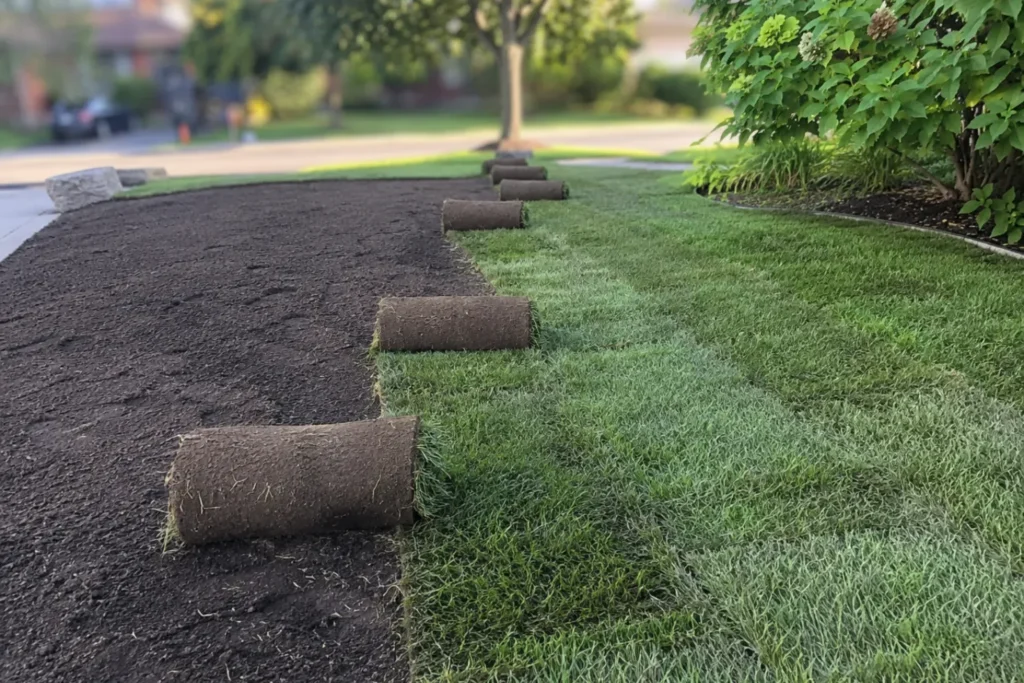
Why one sod quote can be much higher than another
Suppose one contractor quotes $3,000 and another quotes $4,000 for a 1,000-square-foot lawn.
That comparison doesn’t tell you much by itself.
The $3,000 quote might assume that:
- the existing soil is suitable
- little grading is required
- the old grass is easy to remove
- access is straightforward
- disposal is included
- no additional soil is needed
The $4,000 quote might include turf removal, new topsoil, more extensive preparation and difficult access.
Those aren’t necessarily the same job.
Before comparing prices, ask each contractor to spell out the work.
What should be included in a sod installation quote?
A detailed quote should identify as many of these items as apply:
- Existing grass removal
- Disposal of old turf
- Soil removal, if required
- New topsoil
- Soil delivery
- Soil spreading
- Rough grading
- Fine grading
- Corrective grading
- Drainage work
- Sod variety
- Sod quantity
- Sod delivery
- Installation
- Rolling
- Fertilizer
- Cleanup
- HST
- Warranty
You don’t necessarily need every item.
The important thing is knowing what you’re paying for.
A quote that simply says “1,000 sq. ft. sod installation: $4,000” leaves too many questions unanswered.
Removing the existing lawn
If you’re replacing an existing lawn, the old turf has to be dealt with before the new lawn can be properly prepared.
Depending on the property, a contractor may use a sod cutter, machinery or hand tools.
The removal method affects labour and how much soil is removed with the existing turf.
Access matters too.
Removing turf from a large front yard is one thing. Removing it from a backyard at the end of a narrow side passage can involve considerably more labour.
The same applies to the new soil and the sod itself. If materials can’t be brought directly to the work area, they have to be moved by hand or with smaller equipment.
Do you need new topsoil?
Not every lawn needs the same amount of new soil.
A contractor should assess what is already there and determine whether the existing soil can be used, improved or needs to be replaced.
Things that matter include:
- soil quality
- compaction
- drainage
- existing elevations
- how much turf is removed
- the finished grade
- the condition of the underlying soil
Adding the same amount of topsoil to every property isn’t necessarily appropriate.
How much soil is four inches over 1,000 square feet?
If you simply want the volume calculation, four inches over 1,000 square feet is approximately:
12.3 cubic yards
The calculation is:
1,000 × 4/12 ÷ 27 = 12.3 cubic yards
That’s a theoretical volume. It does not mean every 1,000-square-foot Ottawa lawn needs 12.3 cubic yards of imported soil.
The actual amount depends on the site and the finished elevations.
Grading can have a bigger impact than the sod
A new lawn won’t solve a drainage problem underneath it.
If water currently collects beside the house, laying fresh sod over the same grade doesn’t fix the reason the water is collecting there.
The City of Ottawa’s Landscaping Education Guide says you are not allowed to change the grading of a property, and that water cannot be directed to neighbouring properties unless that is part of the approved plan.
That makes grading an important part of a larger lawn replacement project.
There is a difference between fine grading and corrective grading.
Fine grading prepares the surface for the sod and deals with relatively small variations.
Corrective grading is more substantial. It can involve moving significant amounts of soil to address low areas, drainage problems or an incorrect finished elevation.
If a contractor says your yard needs several inches of additional soil, ask where the finished grade will end up.
Adding soil isn’t simply a matter of making the lawn higher. The finished surface has to work with the house, property lines, swales and existing drainage pattern.
Ottawa homes and drainage
This deserves particular attention if you’re changing the elevation of the yard.
A lawn is part of a larger drainage system. Its finished grade has to work with the house, side yards, swales, neighbouring properties and other drainage features.
Ottawa’s landscaping guidance specifically tells property owners to maintain the intended grading and drainage pattern. The City’s site-alteration rules also restrict changes that alter or obstruct drainage in a way that creates, or is likely to create, an adverse condition on an adjoining property.
If you’re planning a substantial change rather than simply replacing an existing lawn at approximately the same elevation, find out what the original grading plan shows before adding large amounts of soil.
What does sod itself cost?
Sod pricing depends on the grass variety, supplier, quantity and delivery.
Kentucky bluegrass is one option used in Ottawa, but suppliers offer different products and blends.
Roll dimensions can also vary.
For example, some suppliers sell rolls measuring 2 feet by 6 feet (12 square feet each), while others sell 2-foot by 5-foot rolls (10 square feet each).
Sod near Ottawa currently costs about $5.80 to $10 per roll, depending on the supplier and whether it is picked up or delivered. Bought by the pallet, supplied and delivered but not installed, it can work out to about $0.83 per square foot.
Don’t assume every supplier uses the same roll dimensions.
If you’re buying the sod yourself, confirm the coverage per roll before calculating how much you need.
How much sod should you order?
Start with the actual lawn area.
A simple 40-by-25-foot lawn is:
40 × 25 = 1,000 square feet
For an irregular lawn, divide it into manageable sections and add the areas together.
Don’t include:
- patios
- walkways
- garden beds
- sheds
- driveways
- areas that won’t receive sod
You should also account for cutting and waste, particularly if the lawn contains curves, trees or narrow sections.
A contractor or sod supplier can help determine the final quantity.
Access can make a surprisingly large difference
Consider two properties, each with 1,000 square feet of lawn.
The first has:
- a wide driveway
- easy truck access
- a level yard
- few obstacles
The second has:
- a backyard behind the house
- a narrow gate
- several mature trees
- compacted soil
- a low area near the foundation
The lawns are the same size.
The labour isn’t.
Soil, removed turf and sod all have to be moved around the property. If a crew can unload close to the work area, the job is simpler than if everything has to be pushed through a narrow passage with wheelbarrows.
That’s one reason square-foot pricing should be treated as a starting point rather than a final quote.
Small lawns can have a high minimum cost
A 200-square-foot repair won’t necessarily cost one-fifth as much as a 1,000-square-foot installation.
There are fixed costs involved in many jobs:
- travel
- scheduling
- crew setup
- delivery
- equipment
- cleanup
For a small lawn or repair, ask for the total project price rather than calculating the cost from a large-job per-square-foot rate.
When is the best time to install sod in Ottawa?
Sod can be installed during the growing season when the ground is workable and the new lawn can be watered properly.
Spring and early fall are commonly favourable periods because temperatures are generally less demanding than during the hottest part of summer.
Summer installation is possible, but newly installed sod can dry out quickly during hot or windy weather.
The more important question is whether you can keep the new lawn adequately watered during establishment.
Before the delivery arrives, make sure you have:
- a usable hose or irrigation system
- access to the entire lawn
- prepared soil
- a watering plan
- enough time to deal with the sod promptly
Fresh sod should be installed promptly after delivery rather than left sitting for an extended period.
How much water does new sod need?
There isn’t one watering schedule that works for every Ottawa lawn.
A new lawn may need frequent watering during hot or windy weather and less during cool, wet conditions.
The appropriate amount depends on:
- temperature
- rainfall
- soil
- sun exposure
- wind
- drainage
- irrigation method
The objective is to keep the root zone moist while the sod establishes without creating runoff or standing water.
Your installer should give you watering instructions appropriate for the site and weather conditions.
Is sod or hydroseeding cheaper?
Hydroseeding generally costs less initially, although it takes longer to produce a finished-looking lawn.
Hydroseeding runs about $0.13 to $0.18 per square foot, and sod placement can easily cost much more. Installed sod in Ottawa runs $3.00 to $4.00 per square foot, but that price can include soil, preparation and delivery that a hydroseeding rate may not, so compare full quotes.
The practical difference is straightforward:
Sod gives you an established-looking lawn immediately. Hydroseeding costs less initially but requires more time for the grass to develop.
For a smaller residential lawn where you want a finished surface quickly, sod may make sense. For larger areas, the economics can be different.
When replacing the lawn isn’t the best solution
A new lawn won’t fix every lawn problem.
Before spending thousands of dollars on sod, consider whether the underlying issue is actually the grass.
Repeated lawn failure can be caused by:
- excessive shade
- poor drainage
- compacted soil
- unsuitable soil
- heavy traffic
- incorrect grading
- insufficient irrigation
If the yard receives very little sunlight, replacing the grass every few years may not solve the underlying problem.
If water remains in the soil for long periods, addressing drainage may be more important than installing new turf.
Sometimes the better sequence is to address the site first and install the lawn afterward.
What should you ask a sod contractor?
Before accepting a quote, ask:
- How much existing turf are you removing?
- Is disposal included?
- How much new soil are you adding?
- What type of soil are you using?
- How deep will the new soil be?
- Is fine grading included?
- Is corrective grading included?
- Are drainage problems included in the price?
- What type of sod are you installing?
- How much sod are you ordering?
- Is delivery included?
- Is HST included?
- What does the warranty cover?
- What watering schedule do you recommend?
- What happens if the sod doesn’t establish properly?
You don’t need to turn the estimate into an hour-long interview.
The important thing is to get the scope in writing.
How to compare two Ottawa sod quotes
Imagine you receive two quotes:
Contractor A: $3,000
Contractor B: $4,000
Don’t compare those totals in isolation.
Put the quotes beside each other and check:
| Item | Quote A | Quote B |
|---|---|---|
| Existing lawn removal | ? | ? |
| Disposal | ? | ? |
| New soil | ? | ? |
| Soil quantity | ? | ? |
| Grading | ? | ? |
| Sod type | ? | ? |
| Sod delivery | ? | ? |
| Installation | ? | ? |
| Cleanup | ? | ? |
| HST | ? | ? |
| Warranty | ? | ? |
You may discover that one contractor assumes the existing soil and grade are already suitable while the other has included substantial preparation.
That’s a much more useful comparison than $3.00 versus $4.00 per square foot.
How to measure your lawn
For a rectangular lawn:
Length × width = square footage
For example:
40 ft × 25 ft = 1,000 sq. ft.
For an L-shaped yard, divide it into rectangles and calculate each section separately.
Don’t include:
- patios
- walkways
- garden beds
- sheds
- driveways
- areas that won’t receive sod
If the lawn is complicated, let the contractor measure it.
A measurement error can become expensive when you’re ordering hundreds or thousands of square feet of sod and soil.
A realistic budget for a 1,000-square-foot lawn
If you’re looking for a starting number, $3,000 to $4,000 is a reasonable range to investigate for Ottawa.
Before assuming that’s what your project will cost, find out what the price includes.
A simple 1,000-square-foot lawn with good access and suitable soil can be relatively straightforward.
A 1,000-square-foot backyard that needs turf removal, imported soil, substantial grading and hand carrying can be a very different project.
If your contractor quotes more than the published per-square-foot range, that doesn’t automatically tell you whether the quote is high or low. There may be additional preparation or site work that the headline rate doesn’t include.
Likewise, a lower quote isn’t necessarily comparable if important preparation, disposal or taxes have been left out.
HST
Ontario’s HST rate is currently 13% for taxable supplies.
If a contractor gives you a pre-tax price of $4,000, 13% HST would bring the total to:
$4,000 × 1.13 = $4,520
Don’t automatically add 13% to an advertised landscaping price. Check whether the contractor’s published price already includes HST.
Bottom line
For Ottawa homeowners, most sod-installation projects run around $3.00 to $4.00 per square foot.
That puts a 1,000-square-foot lawn at approximately $3,000 to $4,000 as a starting budget.
Treat it as a starting point, not a quote.
Before hiring anyone, find out:
- whether the old lawn is being removed
- how disposal is handled
- whether new soil is included
- how much soil is being supplied
- whether grading is included
- what type of sod you’re getting
- whether delivery is included
- whether HST is included
- what the warranty covers
- what you’ll need to do to establish the new lawn
And if the yard has a drainage or grading problem, deal with that before the sod goes down.
New sod can cover an uneven surface. It cannot correct the underlying drainage problem.
Frequently Asked Questions
How much does sod installation cost in Ottawa?
Most Ottawa sod installations run around $3.00 to $4.00 per square foot, although the exact scope varies between contractors.
For 1,000 square feet, that works out to approximately $3,000 to $4,000 before considering site-specific differences.
How much does it cost to sod 1,000 square feet?
Using the range above, approximately $3,000 to $4,000.
Your actual quote may be higher or lower depending on soil, grading, access, removal, disposal and the services included.
Does sod installation include topsoil?
Sometimes.
Some contractors include screened topsoil in their advertised installation price. Others may charge separately.
Ask how much soil is included and what product will be used.
How much topsoil do I need for 1,000 square feet?
Four inches of soil over 1,000 square feet is approximately 12.3 cubic yards.
That’s a volume calculation, not a recommendation that every lawn needs four inches of new soil.
Can you put sod over existing grass?
A complete lawn replacement requires appropriate site preparation rather than simply placing new sod over an intact lawn.
The installer should assess the existing turf, soil and grade and explain what preparation is required.
Does new sod fix drainage problems?
No.
If the yard has a drainage problem, the grade or drainage system needs to be addressed separately.
Putting new sod over a poorly draining area doesn’t solve the underlying problem.
Does Ottawa have rules about property grading?
Yes. The City of Ottawa has rules and guidance concerning lot grading, drainage and site alterations.
The City’s Landscaping Education Guide says you are not allowed to change a property’s grading, and water cannot be directed onto neighbouring properties unless the approved plan allows it.
If you’re substantially changing the grade, check the existing plan and the City’s current requirements before adding large amounts of soil.
How much does sod itself cost?
Ottawa-area suppliers currently list rolls at about $5.80 to $10 each, with each roll covering 10 to 12 square feet. The price varies by supplier, grass variety, quantity and delivery.
Material-only pricing shouldn’t be compared directly with a contractor’s installed price because an installed price may include soil preparation, labour, delivery and other work.
Is sod cheaper than hydroseeding?
Hydroseeding generally costs less initially but takes longer to establish.
Hydroseeding runs about $0.13 to $0.18 per square foot, compared with $3.00 to $4.00 per square foot for installed sod in Ottawa. The sod price can include soil and preparation that a hydroseeding rate may not.
Does landscaping in Ontario have HST?
Taxable landscaping services in Ontario are generally subject to 13% HST.
Check whether the contractor’s quoted price already includes it.
How long does sod installation take?
It depends on the size of the lawn and the amount of preparation required.
Removing turf, bringing in soil, correcting the grade or working through a narrow backyard can add significant time.
Ask the contractor how long they expect your particular project to take.
What should I look for in a sod quote?
At minimum, make sure you understand:
- what is being removed
- what soil is being supplied
- how much grading is included
- what sod is being installed
- whether delivery is included
- whether disposal is included
- whether HST is included
- what the warranty covers
- what watering is required after installation
The more clearly the scope is written, the easier it is to compare one quote with another.